

Definitions,
Values,
DJ's Rights, 7 Stages,
Alternative Providers,
CINDEA Recognition,
Why use Services?
Expectations,
Web of Facets,
Advantages of a DM,
CINDEA Recognition,
Philosophy in Practice
Final
Affairs,
Advance Directives & Representation/Proxy,
Dementia
History,
Why Consider It,
Basics, Videos,
Physical
Care,
6 Shroud Patterns,
DJ's Remains
By
My Own Heart & Hand
Home Funerals, Greening Death, Children & Deathing Rites
Various forms
of
ecological disposition
National
& Provincial
National
& Provincial
National
& Provincial
U.S.A., U.K.,
etc.
for
Adults & Children
Articles & Updates

Definitions,
Values,
DJ's Rights, 7 Stages,
Alternative Providers,
CINDEA Recognition,
Why use Services?
Expectations,
Web of Facets,
Advantages of a DM,
CINDEA Recognition,
Philosophy in Practice
Final
Affairs,
Advance Directives & Representation/Proxy,
Dementia
History,
Why Consider It,
Basics, Videos,
Physical
Care,
6 Shroud Patterns,
DJ's Remains
Various forms
of
ecological disposition
By My
Own Heart & Hand
home funerals, Greening Death, Children, and Deathing Rites
National
& Provincial
National
& Provincial
National
& Provincial
U.S.A., U.K.,
etc.
for
Adults & Children
Articles & Updates
|
|
|

|
Grief,
Ritual and Love: on including children,
instead of excluding them
In
my personal opinion, children are tuned
into the spiritual and emotional world.
In a way, they’ve only
just arrived, much like elders who are nearing
the end of life. They tend to
feel things deeply and intuitively. Even
when adults try to hide their emotions or
avoid the truth, children often sense that
something is wrong. That disconnect
can be confusing, and sometimes even more
distressing than simply being told the truth.
|
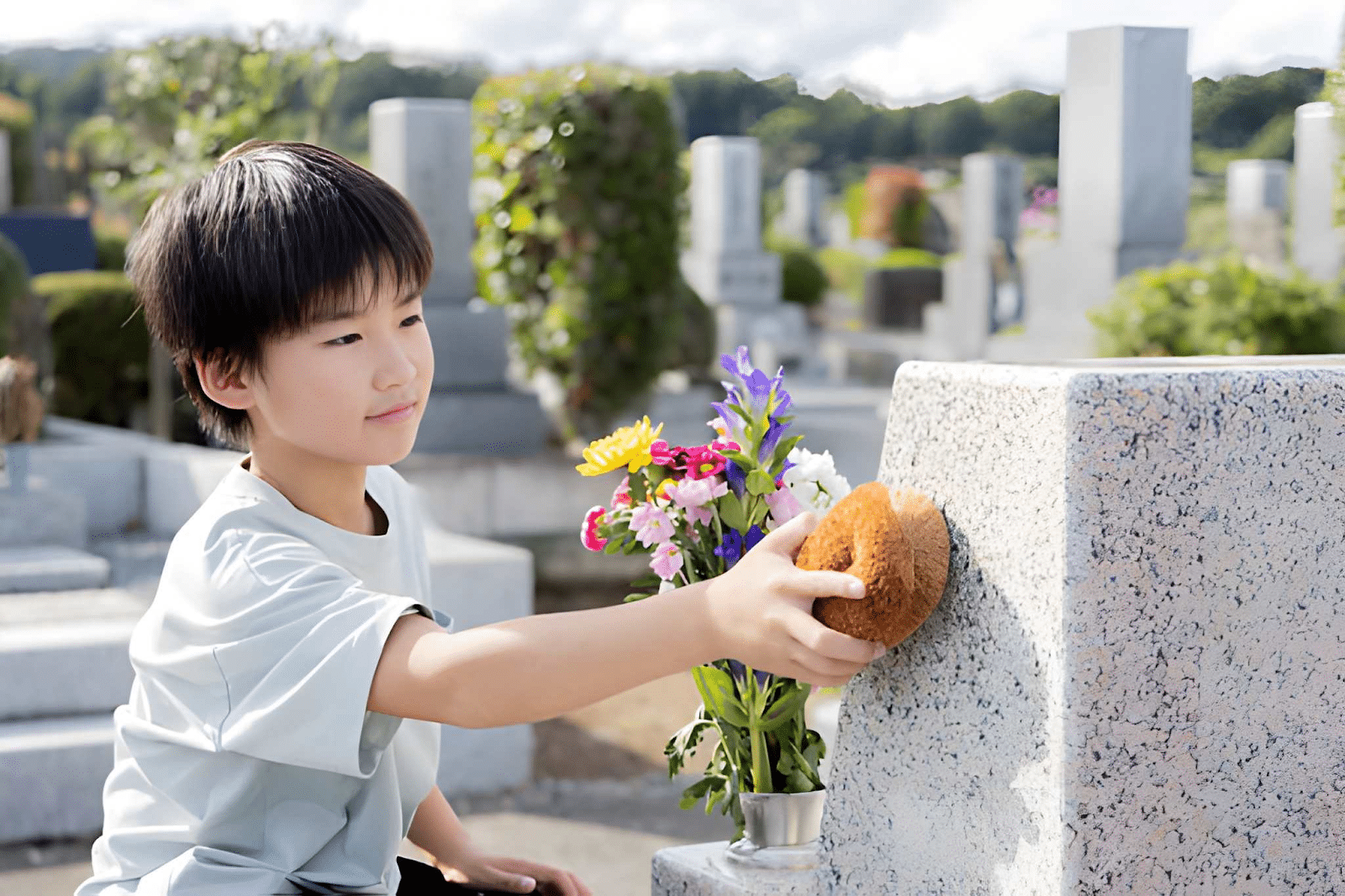
Boy shares his bagel with dead below tombstone! |
In
my experience as a family counsellor, many families
try to protect children by keeping them away from
death, whether that means not allowing them to
attend a funeral or not telling them that someone
has died. But this often seems to
create more confusion and pain. A
child asking “Where is Nana?” over and
over again is usually searching for clarity, not
protection. I believe it’s important
to be open, both emotionally and verbally, with
children. It gives them permission
to feel, to ask questions, and to begin understanding
what’s happening in a way that supports their
grieving process.
I’ve
also witnessed children grieving very intensely,
crying so hard they could barely breathe, especially
at moments like the closing of the casket, sometimes
needing to be physically supported just to walk.
It can be very difficult to witness, and at times
I find myself wondering if it’s too much
for them. At the same time, I try
to remain non-judgmental, because this may also
be a very natural expression of their love and
loss.
I’ll
admit that I do notice from time to time a personal
bias when it comes to very young children, especially
toddlers who are loud and running around. I’ve
seen situations where a lot of attention shifts
toward the toodler, their movement and sounds,
and it can feel distracting from the intention
of the moment, which is to honour the person who
has died. Still, I recognize that
this may simply be my own sensitivity, and I try
to stay aware of that without imposing judgment.
One
story that stayed with me was from a family who
shared that, when they were young, their mother
chose not to hold a funeral for their father.
They described how that absence made
it much harder for them to process and move through
their grief, even years later. It
really reinforced for me how important rituals
are, and how many of them we’ve lost in our
culture. Not only around death, but
around life’s important transitions as well,
moments that deserve to be acknowledged and held
with meaning. Times like a girl getting
her first period, or a boy reaching an age where
he begins to step into adulthood. These
are powerful thresholds, yet they often pass quietly,
without recognition or support. Without
initations, ceremonies or rituals that give shape
to these experiences, it can make transitions
feel confusing, isolating or even invisible. Instead
of acknowledging that something meanignful has
occured.
There’s
a scene in Captain Fantastic that is beautiful
and touching. A father gathers with
his children to cremate their mother outdoors,
by the water. They sing, they dance,
they cry and it’s raw, unconventional, and
so moving. It shows how grief, ritual,
and love can coexist in a way that includes children
rather than excluding them.
March
26 , 2026 ~ Brittany Talarico By
My Heart and Hand student, Montreal
|



Last
updated June 2023 ©
CINDEA (To use more than a brief
extract, please contact
us for permission.) |
|
|
|
|